
Transformers documentation
PoolFormer
This model was published in HF papers on 2021-11-22 and contributed to Hugging Face Transformers on 2022-02-17.
PoolFormer
Overview
The PoolFormer model was proposed in MetaFormer is Actually What You Need for Vision by Sea AI Labs. Instead of designing complicated token mixer to achieve SOTA performance, the target of this work is to demonstrate the competence of transformer models largely stem from the general architecture MetaFormer.
The abstract from the paper is the following:
Transformers have shown great potential in computer vision tasks. A common belief is their attention-based token mixer module contributes most to their competence. However, recent works show the attention-based module in transformers can be replaced by spatial MLPs and the resulted models still perform quite well. Based on this observation, we hypothesize that the general architecture of the transformers, instead of the specific token mixer module, is more essential to the model’s performance. To verify this, we deliberately replace the attention module in transformers with an embarrassingly simple spatial pooling operator to conduct only the most basic token mixing. Surprisingly, we observe that the derived model, termed as PoolFormer, achieves competitive performance on multiple computer vision tasks. For example, on ImageNet-1K, PoolFormer achieves 82.1% top-1 accuracy, surpassing well-tuned vision transformer/MLP-like baselines DeiT-B/ResMLP-B24 by 0.3%/1.1% accuracy with 35%/52% fewer parameters and 48%/60% fewer MACs. The effectiveness of PoolFormer verifies our hypothesis and urges us to initiate the concept of “MetaFormer”, a general architecture abstracted from transformers without specifying the token mixer. Based on the extensive experiments, we argue that MetaFormer is the key player in achieving superior results for recent transformer and MLP-like models on vision tasks. This work calls for more future research dedicated to improving MetaFormer instead of focusing on the token mixer modules. Additionally, our proposed PoolFormer could serve as a starting baseline for future MetaFormer architecture design.
The figure below illustrates the architecture of PoolFormer. Taken from the original paper.
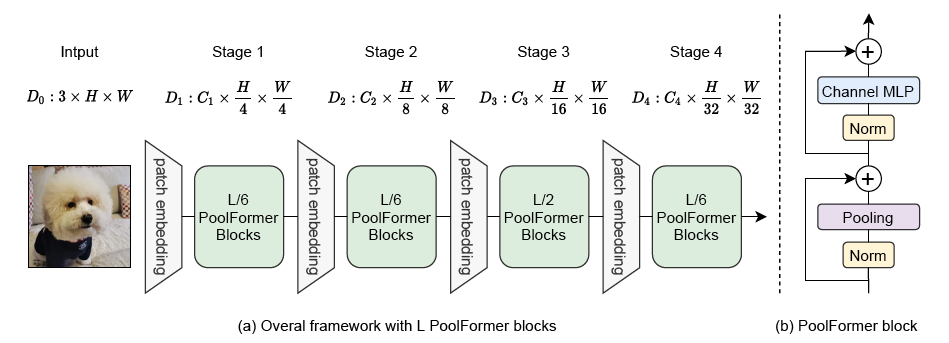
This model was contributed by heytanay. The original code can be found here.
Usage tips
- PoolFormer has a hierarchical architecture, where instead of Attention, a simple Average Pooling layer is present. All checkpoints of the model can be found on the hub.
- One can use PoolFormerImageProcessor to prepare images for the model.
- As most models, PoolFormer comes in different sizes, the details of which can be found in the table below.
| Model variant | Depths | Hidden sizes | Params (M) | ImageNet-1k Top 1 |
|---|---|---|---|---|
| s12 | [2, 2, 6, 2] | [64, 128, 320, 512] | 12 | 77.2 |
| s24 | [4, 4, 12, 4] | [64, 128, 320, 512] | 21 | 80.3 |
| s36 | [6, 6, 18, 6] | [64, 128, 320, 512] | 31 | 81.4 |
| m36 | [6, 6, 18, 6] | [96, 192, 384, 768] | 56 | 82.1 |
| m48 | [8, 8, 24, 8] | [96, 192, 384, 768] | 73 | 82.5 |
Resources
A list of official Hugging Face and community (indicated by 🌎) resources to help you get started with PoolFormer.
- PoolFormerForImageClassification is supported by this example script and notebook.
- See also: Image classification task guide
If you’re interested in submitting a resource to be included here, please feel free to open a Pull Request and we’ll review it! The resource should ideally demonstrate something new instead of duplicating an existing resource.
PoolFormerConfig
class transformers.PoolFormerConfig
< source >( transformers_version: str | None = Nonearchitectures: list[str] | None = Noneoutput_hidden_states: bool | None = Falsereturn_dict: bool | None = Truedtype: str | torch.dtype | None = Nonechunk_size_feed_forward: int = 0is_encoder_decoder: bool = Falseid2label: dict[int, str] | dict[str, str] | None = Nonelabel2id: dict[str, int] | dict[str, str] | None = Noneproblem_type: Literal['regression', 'single_label_classification', 'multi_label_classification'] | None = Nonenum_channels: int = 3patch_size: int | list[int] | tuple[int, int] = 16stride: int = 16pool_size: int = 3mlp_ratio: float = 4.0depths: list[int] | tuple[int, ...] = (2, 2, 6, 2)hidden_sizes: list[int] | tuple[int, ...] = (64, 128, 320, 512)patch_sizes: list[int] | tuple[int, ...] = (7, 3, 3, 3)strides: list[int] | tuple[int, ...] = (4, 2, 2, 2)padding: list[int] | tuple[int, ...] = (2, 1, 1, 1)num_encoder_blocks: int = 4drop_path_rate: float | int = 0.0hidden_act: str = 'gelu'use_layer_scale: bool = Truelayer_scale_init_value: float = 1e-05initializer_range: float = 0.02 )
Parameters
- num_channels (
int, optional, defaults to3) — The number of input channels. - patch_size (
Union[int, list[int], tuple[int, int]], optional, defaults to16) — The size (resolution) of each patch. - stride (
int, optional, defaults to 16) — The stride of the input patch. - pool_size (
int, optional, defaults to 3) — The size of the pooling window. - mlp_ratio (
float, optional, defaults to4.0) — Ratio of the MLP hidden dim to the embedding dim. - depths (
Union[list[int], tuple[int, ...]], optional, defaults to(2, 2, 6, 2)) — Depth of each layer in the Transformer. - hidden_sizes (
Union[list[int], tuple[int, ...]], optional, defaults to(64, 128, 320, 512)) — Dimensionality (hidden size) at each stage of the model. - patch_sizes (
list, optional, defaults to[7, 3, 3, 3]) — The size of the input patch for each encoder block. - strides (
list, optional, defaults to[4, 2, 2, 2]) — The stride of the input patch for each encoder block. - padding (
list, optional, defaults to[2, 1, 1, 1]) — The padding of the input patch for each encoder block. - num_encoder_blocks (
int, optional, defaults to 4) — The number of encoder blocks. - drop_path_rate (
Union[float, int], optional, defaults to0.0) — Drop path rate for the patch fusion. - hidden_act (
str, optional, defaults togelu) — The non-linear activation function (function or string) in the decoder. For example,"gelu","relu","silu", etc. - use_layer_scale (
bool, optional, defaults toTrue) — Whether to use layer scale. - layer_scale_init_value (
float, optional, defaults to1e-05) — Scale to use in the self-attention layers. 0.1 for base, 1e-6 for large. Set 0 to disable layer scale. - initializer_range (
float, optional, defaults to0.02) — The standard deviation of the truncated_normal_initializer for initializing all weight matrices.
This is the configuration class to store the configuration of a PoolFormerModel. It is used to instantiate a Poolformer model according to the specified arguments, defining the model architecture. Instantiating a configuration with the defaults will yield a similar configuration to that of the sail/poolformer_s12
Configuration objects inherit from PreTrainedConfig and can be used to control the model outputs. Read the documentation from PreTrainedConfig for more information.
Example:
>>> from transformers import PoolFormerConfig, PoolFormerModel

>>> # Initializing a PoolFormer sail/poolformer_s12 style configuration
>>> configuration = PoolFormerConfig()

>>> # Initializing a model (with random weights) from the sail/poolformer_s12 style configuration
>>> model = PoolFormerModel(configuration)

>>> # Accessing the model configuration
>>> configuration = model.config
PoolFormerImageProcessor
class transformers.PoolFormerImageProcessor
< source >( **kwargs: Unpack )
Parameters
- do_convert_rgb (
bool, kwargs, optional, defaults toNone) — Whether to convert the image to RGB. - do_resize (
bool, kwargs, optional, defaults toTrue) — Whether to resize the image. - size (
Annotated[int | list[int] | tuple[int, ...] | dict[str, int] | None, None], kwargs, defaults to{'shortest_edge' -- 224}): Describes the maximum input dimensions to the model. - default_to_square (
bool, kwargs, optional, defaults toFalse) — Whether to default to a square image when resizing, if size is an int. - crop_size (
Annotated[int | list[int] | tuple[int, ...] | dict[str, int] | None, None], kwargs, defaults to{'height' -- 224, 'width': 224}): Size of the output image after applyingcenter_crop. - resample (
Annotated[Union[int, PILImageResampling, NoneType], None], kwargs, defaults toResampling.BICUBIC) — Resampling filter to use if resizing the image. This can be one of the enumPILImageResampling. Only has an effect ifdo_resizeis set toTrue. - do_rescale (
bool, kwargs, optional, defaults toTrue) — Whether to rescale the image. - rescale_factor (
float, kwargs, optional, defaults to0.00392156862745098) — Rescale factor to rescale the image by ifdo_rescaleis set toTrue. - do_normalize (
bool, kwargs, optional, defaults toTrue) — Whether to normalize the image. - image_mean (
Union[float, list[float], tuple[float, ...]], kwargs, optional, defaults to[0.485, 0.456, 0.406]) — Image mean to use for normalization. Only has an effect ifdo_normalizeis set toTrue. - image_std (
Union[float, list[float], tuple[float, ...]], kwargs, optional, defaults to[0.229, 0.224, 0.225]) — Image standard deviation to use for normalization. Only has an effect ifdo_normalizeis set toTrue. - do_pad (
bool, kwargs, optional) — Whether to pad the image. Padding is done either to the largest size in the batch or to a fixed square size per image. The exact padding strategy depends on the model. - pad_size (
Annotated[int | list[int] | tuple[int, ...] | dict[str, int] | None, None], kwargs) — The size in{"height": int, "width" int}to pad the images to. Must be larger than any image size provided for preprocessing. Ifpad_sizeis not provided, images will be padded to the largest height and width in the batch. Applied only whendo_pad=True. - do_center_crop (
bool, kwargs, optional, defaults toTrue) — Whether to center crop the image. - data_format (
Union[str, ~image_utils.ChannelDimension], kwargs, optional) — OnlyChannelDimension.FIRSTis supported. Added for compatibility with slow processors. - input_data_format (
Union[str, ~image_utils.ChannelDimension], kwargs, optional) — The channel dimension format for the input image. If unset, the channel dimension format is inferred from the input image. Can be one of:"channels_first"orChannelDimension.FIRST: image in (num_channels, height, width) format."channels_last"orChannelDimension.LAST: image in (height, width, num_channels) format."none"orChannelDimension.NONE: image in (height, width) format.
- device (
Annotated[Union[str, torch.device, NoneType], None], kwargs) — The device to process the videos on. If unset, the device is inferred from the input videos. - return_tensors (
Annotated[str | ~utils.generic.TensorType | None, None], kwargs) — Returns stacked tensors if set to'pt', otherwise returns a list of tensors. - disable_grouping (
bool, kwargs, optional) — Whether to disable grouping of images by size to process them individually and not in batches. If None, will be set to True if the images are on CPU, and False otherwise. This choice is based on empirical observations, as detailed here: https://github.com/huggingface/transformers/pull/38157 - image_seq_length (
int, kwargs, optional) — The number of image tokens to be used for each image in the input. Added for backward compatibility but this should be set as a processor attribute in future models. - crop_pct (
float, kwargs, optional, defaults toself.crop_pct) — Percentage of the image to crop. Only has an effect ifdo_resizeis set toTrue.
Constructs a PoolFormerImageProcessor image processor.
preprocess
< source >( images: typing.Union[ForwardRef('PIL.Image.Image'), numpy.ndarray, ForwardRef('torch.Tensor'), list['PIL.Image.Image'], list[numpy.ndarray], list['torch.Tensor']]*argsimage_like_kwargs: dict[str, typing.Any] | None = None**kwargs: Unpack ) → ~image_processing_base.BatchFeature
Parameters
- images (
Union[PIL.Image.Image, numpy.ndarray, torch.Tensor, list[PIL.Image.Image], list[numpy.ndarray], list[torch.Tensor]]) — Image to preprocess. Expects a single or batch of images with pixel values ranging from 0 to 255. If passing in images with pixel values between 0 and 1, setdo_rescale=False. - do_convert_rgb (
bool, kwargs, optional) — Whether to convert the image to RGB. - do_resize (
bool, kwargs, optional) — Whether to resize the image. - size (
Annotated[int | list[int] | tuple[int, ...] | dict[str, int] | None, None], kwargs) — Describes the maximum input dimensions to the model. - default_to_square (
bool, kwargs, optional) — Whether to default to a square image when resizing, if size is an int. - crop_size (
Annotated[int | list[int] | tuple[int, ...] | dict[str, int] | None, None], kwargs) — Size of the output image after applyingcenter_crop. - resample (
Annotated[Union[int, PILImageResampling, NoneType], None], kwargs) — Resampling filter to use if resizing the image. This can be one of the enumPILImageResampling. Only has an effect ifdo_resizeis set toTrue. - do_rescale (
bool, kwargs, optional) — Whether to rescale the image. - rescale_factor (
float, kwargs, optional) — Rescale factor to rescale the image by ifdo_rescaleis set toTrue. - do_normalize (
bool, kwargs, optional) — Whether to normalize the image. - image_mean (
Union[float, list[float], tuple[float, ...]], kwargs, optional) — Image mean to use for normalization. Only has an effect ifdo_normalizeis set toTrue. - image_std (
Union[float, list[float], tuple[float, ...]], kwargs, optional) — Image standard deviation to use for normalization. Only has an effect ifdo_normalizeis set toTrue. - do_pad (
bool, kwargs, optional) — Whether to pad the image. Padding is done either to the largest size in the batch or to a fixed square size per image. The exact padding strategy depends on the model. - pad_size (
Annotated[int | list[int] | tuple[int, ...] | dict[str, int] | None, None], kwargs) — The size in{"height": int, "width" int}to pad the images to. Must be larger than any image size provided for preprocessing. Ifpad_sizeis not provided, images will be padded to the largest height and width in the batch. Applied only whendo_pad=True. - do_center_crop (
bool, kwargs, optional) — Whether to center crop the image. - data_format (
Union[str, ~image_utils.ChannelDimension], kwargs, optional) — OnlyChannelDimension.FIRSTis supported. Added for compatibility with slow processors. - input_data_format (
Union[str, ~image_utils.ChannelDimension], kwargs, optional) — The channel dimension format for the input image. If unset, the channel dimension format is inferred from the input image. Can be one of:"channels_first"orChannelDimension.FIRST: image in (num_channels, height, width) format."channels_last"orChannelDimension.LAST: image in (height, width, num_channels) format."none"orChannelDimension.NONE: image in (height, width) format.
- device (
Annotated[Union[str, torch.device, NoneType], None], kwargs) — The device to process the videos on. If unset, the device is inferred from the input videos. - return_tensors (
Annotated[str | ~utils.generic.TensorType | None, None], kwargs) — Returns stacked tensors if set to'pt', otherwise returns a list of tensors. - disable_grouping (
bool, kwargs, optional) — Whether to disable grouping of images by size to process them individually and not in batches. If None, will be set to True if the images are on CPU, and False otherwise. This choice is based on empirical observations, as detailed here: https://github.com/huggingface/transformers/pull/38157 - image_seq_length (
int, kwargs, optional) — The number of image tokens to be used for each image in the input. Added for backward compatibility but this should be set as a processor attribute in future models.
Returns
~image_processing_base.BatchFeature
- data (
dict) — Dictionary of lists/arrays/tensors returned by the call method (‘pixel_values’, etc.). - tensor_type (
Union[None, str, TensorType], optional) — You can give a tensor_type here to convert the lists of integers in PyTorch/Numpy Tensors at initialization.
PoolFormerImageProcessorPil
class transformers.PoolFormerImageProcessorPil
< source >( **kwargs: Unpack )
Parameters
- do_convert_rgb (
bool, kwargs, optional, defaults toNone) — Whether to convert the image to RGB. - do_resize (
bool, kwargs, optional, defaults toTrue) — Whether to resize the image. - size (
Annotated[int | list[int] | tuple[int, ...] | dict[str, int] | None, None], kwargs, defaults to{'shortest_edge' -- 224}): Describes the maximum input dimensions to the model. - default_to_square (
bool, kwargs, optional, defaults toFalse) — Whether to default to a square image when resizing, if size is an int. - crop_size (
Annotated[int | list[int] | tuple[int, ...] | dict[str, int] | None, None], kwargs, defaults to{'height' -- 224, 'width': 224}): Size of the output image after applyingcenter_crop. - resample (
Annotated[Union[int, PILImageResampling, NoneType], None], kwargs, defaults toResampling.BICUBIC) — Resampling filter to use if resizing the image. This can be one of the enumPILImageResampling. Only has an effect ifdo_resizeis set toTrue. - do_rescale (
bool, kwargs, optional, defaults toTrue) — Whether to rescale the image. - rescale_factor (
float, kwargs, optional, defaults to0.00392156862745098) — Rescale factor to rescale the image by ifdo_rescaleis set toTrue. - do_normalize (
bool, kwargs, optional, defaults toTrue) — Whether to normalize the image. - image_mean (
Union[float, list[float], tuple[float, ...]], kwargs, optional, defaults to[0.485, 0.456, 0.406]) — Image mean to use for normalization. Only has an effect ifdo_normalizeis set toTrue. - image_std (
Union[float, list[float], tuple[float, ...]], kwargs, optional, defaults to[0.229, 0.224, 0.225]) — Image standard deviation to use for normalization. Only has an effect ifdo_normalizeis set toTrue. - do_pad (
bool, kwargs, optional) — Whether to pad the image. Padding is done either to the largest size in the batch or to a fixed square size per image. The exact padding strategy depends on the model. - pad_size (
Annotated[int | list[int] | tuple[int, ...] | dict[str, int] | None, None], kwargs) — The size in{"height": int, "width" int}to pad the images to. Must be larger than any image size provided for preprocessing. Ifpad_sizeis not provided, images will be padded to the largest height and width in the batch. Applied only whendo_pad=True. - do_center_crop (
bool, kwargs, optional, defaults toTrue) — Whether to center crop the image. - data_format (
Union[str, ~image_utils.ChannelDimension], kwargs, optional) — OnlyChannelDimension.FIRSTis supported. Added for compatibility with slow processors. - input_data_format (
Union[str, ~image_utils.ChannelDimension], kwargs, optional) — The channel dimension format for the input image. If unset, the channel dimension format is inferred from the input image. Can be one of:"channels_first"orChannelDimension.FIRST: image in (num_channels, height, width) format."channels_last"orChannelDimension.LAST: image in (height, width, num_channels) format."none"orChannelDimension.NONE: image in (height, width) format.
- device (
Annotated[Union[str, torch.device, NoneType], None], kwargs) — The device to process the videos on. If unset, the device is inferred from the input videos. - return_tensors (
Annotated[str | ~utils.generic.TensorType | None, None], kwargs) — Returns stacked tensors if set to'pt', otherwise returns a list of tensors. - disable_grouping (
bool, kwargs, optional) — Whether to disable grouping of images by size to process them individually and not in batches. If None, will be set to True if the images are on CPU, and False otherwise. This choice is based on empirical observations, as detailed here: https://github.com/huggingface/transformers/pull/38157 - image_seq_length (
int, kwargs, optional) — The number of image tokens to be used for each image in the input. Added for backward compatibility but this should be set as a processor attribute in future models. - crop_pct (
float, kwargs, optional, defaults toself.crop_pct) — Percentage of the image to crop. Only has an effect ifdo_resizeis set toTrue.
Constructs a PoolFormerImageProcessor image processor.
preprocess
< source >( images: typing.Union[ForwardRef('PIL.Image.Image'), numpy.ndarray, ForwardRef('torch.Tensor'), list['PIL.Image.Image'], list[numpy.ndarray], list['torch.Tensor']]*argsimage_like_kwargs: dict[str, typing.Any] | None = None**kwargs: Unpack ) → ~image_processing_base.BatchFeature
Parameters
- images (
Union[PIL.Image.Image, numpy.ndarray, torch.Tensor, list[PIL.Image.Image], list[numpy.ndarray], list[torch.Tensor]]) — Image to preprocess. Expects a single or batch of images with pixel values ranging from 0 to 255. If passing in images with pixel values between 0 and 1, setdo_rescale=False. - do_convert_rgb (
bool, kwargs, optional) — Whether to convert the image to RGB. - do_resize (
bool, kwargs, optional) — Whether to resize the image. - size (
Annotated[int | list[int] | tuple[int, ...] | dict[str, int] | None, None], kwargs) — Describes the maximum input dimensions to the model. - default_to_square (
bool, kwargs, optional) — Whether to default to a square image when resizing, if size is an int. - crop_size (
Annotated[int | list[int] | tuple[int, ...] | dict[str, int] | None, None], kwargs) — Size of the output image after applyingcenter_crop. - resample (
Annotated[Union[int, PILImageResampling, NoneType], None], kwargs) — Resampling filter to use if resizing the image. This can be one of the enumPILImageResampling. Only has an effect ifdo_resizeis set toTrue. - do_rescale (
bool, kwargs, optional) — Whether to rescale the image. - rescale_factor (
float, kwargs, optional) — Rescale factor to rescale the image by ifdo_rescaleis set toTrue. - do_normalize (
bool, kwargs, optional) — Whether to normalize the image. - image_mean (
Union[float, list[float], tuple[float, ...]], kwargs, optional) — Image mean to use for normalization. Only has an effect ifdo_normalizeis set toTrue. - image_std (
Union[float, list[float], tuple[float, ...]], kwargs, optional) — Image standard deviation to use for normalization. Only has an effect ifdo_normalizeis set toTrue. - do_pad (
bool, kwargs, optional) — Whether to pad the image. Padding is done either to the largest size in the batch or to a fixed square size per image. The exact padding strategy depends on the model. - pad_size (
Annotated[int | list[int] | tuple[int, ...] | dict[str, int] | None, None], kwargs) — The size in{"height": int, "width" int}to pad the images to. Must be larger than any image size provided for preprocessing. Ifpad_sizeis not provided, images will be padded to the largest height and width in the batch. Applied only whendo_pad=True. - do_center_crop (
bool, kwargs, optional) — Whether to center crop the image. - data_format (
Union[str, ~image_utils.ChannelDimension], kwargs, optional) — OnlyChannelDimension.FIRSTis supported. Added for compatibility with slow processors. - input_data_format (
Union[str, ~image_utils.ChannelDimension], kwargs, optional) — The channel dimension format for the input image. If unset, the channel dimension format is inferred from the input image. Can be one of:"channels_first"orChannelDimension.FIRST: image in (num_channels, height, width) format."channels_last"orChannelDimension.LAST: image in (height, width, num_channels) format."none"orChannelDimension.NONE: image in (height, width) format.
- device (
Annotated[Union[str, torch.device, NoneType], None], kwargs) — The device to process the videos on. If unset, the device is inferred from the input videos. - return_tensors (
Annotated[str | ~utils.generic.TensorType | None, None], kwargs) — Returns stacked tensors if set to'pt', otherwise returns a list of tensors. - disable_grouping (
bool, kwargs, optional) — Whether to disable grouping of images by size to process them individually and not in batches. If None, will be set to True if the images are on CPU, and False otherwise. This choice is based on empirical observations, as detailed here: https://github.com/huggingface/transformers/pull/38157 - image_seq_length (
int, kwargs, optional) — The number of image tokens to be used for each image in the input. Added for backward compatibility but this should be set as a processor attribute in future models.
Returns
~image_processing_base.BatchFeature
- data (
dict) — Dictionary of lists/arrays/tensors returned by the call method (‘pixel_values’, etc.). - tensor_type (
Union[None, str, TensorType], optional) — You can give a tensor_type here to convert the lists of integers in PyTorch/Numpy Tensors at initialization.
PoolFormerModel
class transformers.PoolFormerModel
< source >( config )
Parameters
- config (PoolFormerModel) — Model configuration class with all the parameters of the model. Initializing with a config file does not load the weights associated with the model, only the configuration. Check out the from_pretrained() method to load the model weights.
The bare Poolformer Model outputting raw hidden-states without any specific head on top.
This model inherits from PreTrainedModel. Check the superclass documentation for the generic methods the library implements for all its model (such as downloading or saving, resizing the input embeddings, pruning heads etc.)
This model is also a PyTorch torch.nn.Module subclass. Use it as a regular PyTorch Module and refer to the PyTorch documentation for all matter related to general usage and behavior.
forward
< source >( pixel_values: typing.Optional[torch.FloatTensor] = Noneoutput_hidden_states: bool | None = Nonereturn_dict: bool | None = None**kwargs ) → BaseModelOutputWithNoAttention or tuple(torch.FloatTensor)
Parameters
- pixel_values (
torch.FloatTensorof shape(batch_size, num_channels, image_size, image_size), optional) — The tensors corresponding to the input images. Pixel values can be obtained using PoolFormerImageProcessor. SeePoolFormerImageProcessor.__call__()for details (processor_classuses PoolFormerImageProcessor for processing images). - output_hidden_states (
bool, optional) — Whether or not to return the hidden states of all layers. Seehidden_statesunder returned tensors for more detail. - return_dict (
bool, optional) — Whether or not to return a ModelOutput instead of a plain tuple.
Returns
BaseModelOutputWithNoAttention or tuple(torch.FloatTensor)
A BaseModelOutputWithNoAttention or a tuple of
torch.FloatTensor (if return_dict=False is passed or when config.return_dict=False) comprising various
elements depending on the configuration (PoolFormerConfig) and inputs.
The PoolFormerModel forward method, overrides the __call__ special method.
Although the recipe for forward pass needs to be defined within this function, one should call the
Moduleinstance afterwards instead of this since the former takes care of running the pre and post processing steps while the latter silently ignores them.
last_hidden_state (
torch.FloatTensorof shape(batch_size, num_channels, height, width)) — Sequence of hidden-states at the output of the last layer of the model.hidden_states (
tuple(torch.FloatTensor), optional, returned whenoutput_hidden_states=Trueis passed or whenconfig.output_hidden_states=True) — Tuple oftorch.FloatTensor(one for the output of the embeddings, if the model has an embedding layer, + one for the output of each layer) of shape(batch_size, num_channels, height, width).Hidden-states of the model at the output of each layer plus the optional initial embedding outputs.
PoolFormerForImageClassification
class transformers.PoolFormerForImageClassification
< source >( config )
Parameters
- config (PoolFormerForImageClassification) — Model configuration class with all the parameters of the model. Initializing with a config file does not load the weights associated with the model, only the configuration. Check out the from_pretrained() method to load the model weights.
PoolFormer Model transformer with an image classification head on top
This model inherits from PreTrainedModel. Check the superclass documentation for the generic methods the library implements for all its model (such as downloading or saving, resizing the input embeddings, pruning heads etc.)
This model is also a PyTorch torch.nn.Module subclass. Use it as a regular PyTorch Module and refer to the PyTorch documentation for all matter related to general usage and behavior.
forward
< source >( pixel_values: typing.Optional[torch.FloatTensor] = Nonelabels: typing.Optional[torch.LongTensor] = Noneoutput_hidden_states: bool | None = Nonereturn_dict: bool | None = None**kwargs ) → ImageClassifierOutputWithNoAttention or tuple(torch.FloatTensor)
Parameters
- pixel_values (
torch.FloatTensorof shape(batch_size, num_channels, image_size, image_size), optional) — The tensors corresponding to the input images. Pixel values can be obtained using PoolFormerImageProcessor. SeePoolFormerImageProcessor.__call__()for details (processor_classuses PoolFormerImageProcessor for processing images). - labels (
torch.LongTensorof shape(batch_size,), optional) — Labels for computing the image classification/regression loss. Indices should be in[0, ..., config.num_labels - 1]. Ifconfig.num_labels == 1a regression loss is computed (Mean-Square loss), Ifconfig.num_labels > 1a classification loss is computed (Cross-Entropy). - output_hidden_states (
bool, optional) — Whether or not to return the hidden states of all layers. Seehidden_statesunder returned tensors for more detail. - return_dict (
bool, optional) — Whether or not to return a ModelOutput instead of a plain tuple.
Returns
ImageClassifierOutputWithNoAttention or tuple(torch.FloatTensor)
A ImageClassifierOutputWithNoAttention or a tuple of
torch.FloatTensor (if return_dict=False is passed or when config.return_dict=False) comprising various
elements depending on the configuration (PoolFormerConfig) and inputs.
The PoolFormerForImageClassification forward method, overrides the __call__ special method.
Although the recipe for forward pass needs to be defined within this function, one should call the
Moduleinstance afterwards instead of this since the former takes care of running the pre and post processing steps while the latter silently ignores them.
- loss (
torch.FloatTensorof shape(1,), optional, returned whenlabelsis provided) — Classification (or regression if config.num_labels==1) loss. - logits (
torch.FloatTensorof shape(batch_size, config.num_labels)) — Classification (or regression if config.num_labels==1) scores (before SoftMax). - hidden_states (
tuple(torch.FloatTensor), optional, returned whenoutput_hidden_states=Trueis passed or whenconfig.output_hidden_states=True) — Tuple oftorch.FloatTensor(one for the output of the embeddings, if the model has an embedding layer, + one for the output of each stage) of shape(batch_size, num_channels, height, width). Hidden-states (also called feature maps) of the model at the output of each stage.
Example:
>>> from transformers import AutoImageProcessor, PoolFormerForImageClassification
>>> import torch
>>> from datasets import load_dataset

>>> dataset = load_dataset("huggingface/cats-image")
>>> image = dataset["test"]["image"][0]

>>> image_processor = AutoImageProcessor.from_pretrained("sail/poolformer_s12")
>>> model = PoolFormerForImageClassification.from_pretrained("sail/poolformer_s12")

>>> inputs = image_processor(image, return_tensors="pt")

>>> with torch.no_grad():
...     logits = model(**inputs).logits

>>> # model predicts one of the 1000 ImageNet classes
>>> predicted_label = logits.argmax(-1).item()
>>> print(model.config.id2label[predicted_label])
...